Building NorthList: a task manager I actually own
I got tired of task apps that hold my data hostage. Todoist wants a subscription. Notion is a browser tab that eats RAM for breakfast. TickTick syncs to servers I don't control. So I built my own.
NorthList is a self-hosted, single-user task manager running on my home network. It does everything I actually need and nothing I don't. Here's how it came together, and what went sideways along the way.
The stack
I went with a monorepo layout under packages/backend and packages/frontend:
- Backend: Fastify + better-sqlite3. Fast, lightweight, no ORM bloat. SQLite means the entire database is one file I can back up with a copy command.
- Frontend: React + Vite. Vite's hot reload keeps the dev loop tight — changes show up before I finish alt-tabbing to the browser.
The whole thing lives at E:\Hermes Projects\northlist and gets pushed to my self-hosted Gitea instance. No GitHub, no cloud dependency.
What it does
The feature list grew organically based on what I actually reached for day to day:
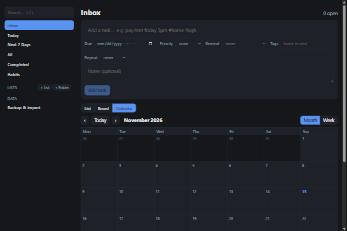
- Tasks with due dates, priorities (1–4), and recurrence rules
- Subtasks for breaking down bigger items
- Lists and folders for organization, plus tags for cross-cutting categories
- Habits tracking alongside regular tasks
- Calendar view (month and week) and a board view with drag-and-drop
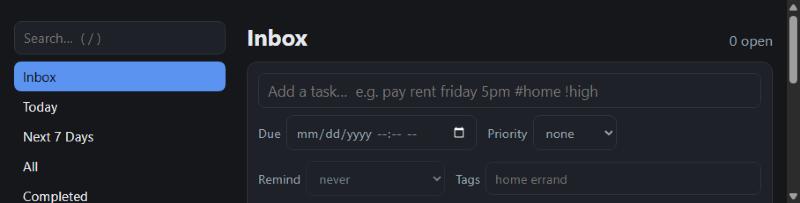
- Quick-add with natural language date parsing — type "buy filters friday" and it figures it out
- Backup and restore built in, because SQLite makes that trivial
It's single-user by design. No auth system, no multi-tenant patterns, no invite flows. That keeps the codebase small and the attack surface smaller.
The calendar question: ICS won
I wanted NorthList tasks to show up in Google Calendar. Two options:
- Full Google Calendar API sync — OAuth, token refresh, webhook subscriptions, conflict resolution. A real integration.
- ICS feed endpoint — serve a
.icsfile at/api/calendar.ics, subscribe from Google Calendar, let Google poll it.
I went with ICS. A twice-daily refresh is fine for tasks. The implementation is a single route that loops through tasks with due dates and formats them as VEVENT blocks. No OAuth dance, no token storage, no Google SDK dependency. It just works.
Where Hermes made things harder
Hermes is the AI agent I built around my local LLM setup — it handles a daily briefing, answers questions about my projects, and is meant to eventually plug into NorthList for smart task suggestions.
The problem: my local LLM runs on an RTX 4070 Ti with 12 GB of VRAM. That's enough for MoE models with ~3 billion active parameters, but context windows are the bottleneck. Force 16k context and speed drops 35–55% as the GPU spills into shared memory. Hermes sessions that need to hold a full conversation history — like reviewing a day's worth of tasks and suggesting priorities — hit that wall hard.
I tried Ghost-Infer as a faster alternative to LM Studio for the Qwen3.6-35B model Hermes uses, and it was dramatically faster on that specific model. But it couldn't load half my other models and had quirks that made it unreliable as a daily driver. More on that in the next post.
The short version: Hermes works, but the local LLM integration for NorthList is still on the roadmap. The VRAM constraint means I need to be strategic about when and how the LLM gets involved — short, focused prompts rather than long conversational sessions.
What's next
- Local LLM integration: Connect NorthList to LM Studio at
localhost:1234for task suggestions and natural language queries. The key is keeping prompts short so the 12 GB VRAM stays comfortable. - Better recurrence: Monthly "last weekday" patterns and skip-if-completed logic.
- Mobile view: The React frontend works on a phone browser over Tailscale, but the touch targets need work.
NorthList is the kind of project that'll never be "done" — it just has to stay useful. So far, it is.